Contemporary Challenges: Fall-2026
Homework 1: Due Week 1 Friday (10/2)
- Travel by car or bike
(Remember to read the Homework-Write-Up Guide)
In this question you will compare the energy used by (i) an electric bicycle traveling 15 miles at 15 mph to (ii) the energy used by an electric car traveling the same distance at 60 miles per hour.
- Find the ratio of the energies used by the two options. I'm looking for a numerical value of the ratio. Use the simplest coarse-grained model for transport (kinetic energy of the wind tail) and clearly state your assumptions (for example, assume flat roads).
- Use a more refined model by including rolling resistance. The rolling resistance for cars and bicyles is equivalent to climbing an uphill grade of approximately 1%. (The exact value of the equivalent uphill grade depends on the tire pressure, and the viscoelasticity of the tire material).
- Speed of a solar car
This self-driving solar car is travelling on a flat road on a windless day. The sun is directly overhead.
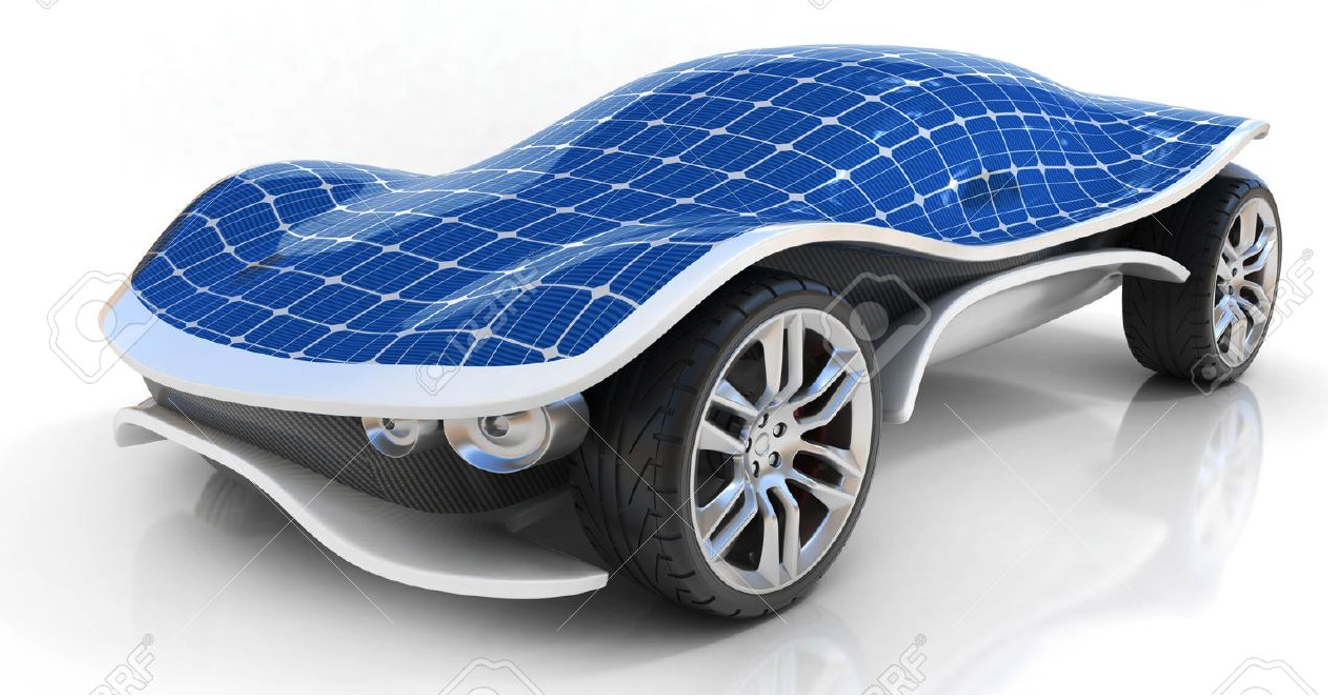
(a) Draw an energy flow diagram to describe the system. An arrow at the top of the flow diagram will represent incoming solar energy (landing on the solar panel). One circle will represent the solar panel, and one circle will represent the electric motor. Label each arrow with the correponding value of energy flow (a quantity measured in joules per second).
(b) Estimate how fast this self-driving solar car can travel on a flat road on a windless day when the sun is directly overhead. Give your answer in meters per second.
Use the following parameters for the system:
- The car is 1.8 m wide, 1 m tall and 3 m long. The top surface of the car is entirely covered with solar panels.
- The sun is directly overhead and the intensity of the sunlight is 1000 J/(s.m\(^2\)).
- The electric motors are powered directly by the solar panels (no battery power).
- The solar panels convert sunlight energy into electrical energy with 20% efficiency (the other 80% of sunlight energy is heating the solar panel).
- The electric motors convert electrical energy into mechanical work with efficiency 90% efficiency.
- The drag coefficient is 0.2.
- The energy dissipation associated with the tires rolling on the road can be neglicted.
- Piano tuners in Chicago
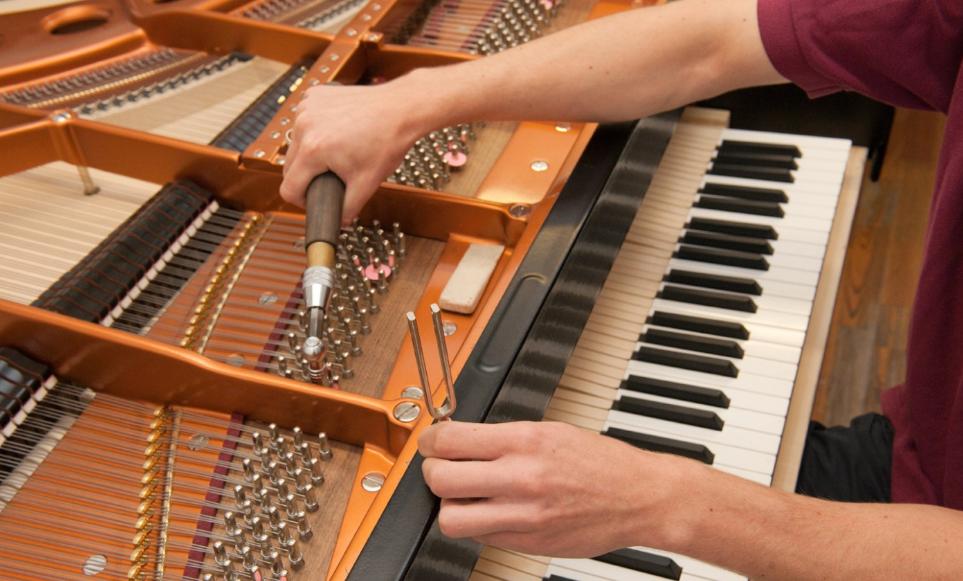
In a fabled story about Enrico Fermi (famous physicist), Fermi was asked how many people work as piano tuners in Chicago. Fermi did some mental arithmetic and quickly answered the question with surprising accuracy. Your task is to recreate Fermi's calculation.
Fermi's approach to solving such problems has spread far beyond the physics community. Today, tech companies and business consulting companies expect their employees to do Fermi problems: https://www.youtube.com/watch?v=KAo6Vn5bDF0.
Background: Pianos were popular when Fermi was living in Chicago in the 1940s. The population of Chicago was about 2 million people. Approximately 1 in 10 households had a piano. Pianos got out of tune at regular intervals (about 2 or 3 years), so the piano owner would call a technician (the piano tuner) to tighten/loosen the 88 strings inside the piano. Each tuning job took at least an hour.
Fermi used his general knowledge to estimate proportionality constants: For example, the number of pianos in Chicago was proportional to the number of households (the proporitionality constant was 0.1.).
To recreate Fermi's calculation make your own quantitaive estimates of proportionality constants (practice using your reasoning skills; avoid using Google). Each proportionality constant will be approximate; that is the essence of this estimation technique. To organize your calculation in a logical, easy-to-follow fashion, set up each line of math with one proportionality constant. For example,
\begin{align} ``(2 \times 10^6 \text{ people}) \div (3 \text{ people per household}) = 0.7 \times 10^6 \text{ households}'' \end{align}
Keep track of units as you go along: households, pianos, hours, etc. Use round numbers at each step of the calculation because a 5% calculational “error” will be smaller than the 10-30% uncertainty in the proportionality constants. How many piano tuners do you think were working in Chicago in the 1940s?
- Three ideas for the term project
Read the description of the term project on the class website at “Introduction to term project”. Identify three (3) subjects that you find interesting/intriguing (for example, solar energy, exoplanets, ...). Within each subject, pose a question that might have an interesting quantitative answer: “Since it requires energy to make a solar panel, how long does it take to recoup that energy?”, “How far away could we see an Earth-like planet orbiting a Sun-like star?” ... You should turn in 3 different subjects and 3 different quantitative questions (quantitative means “quantities that can be calculated and/or measured”)
Let your mind wander as broadly as possible. Subjects and questions are not restricted to the topics taught in PH315. During this exploratory stage, be bold and daring; you are not committing yourself to solve all 3 questions. To spark your imagination, there is a list of ideas on the class website. The instructor will read your ideas and give you feedback. Whenever possible, the feedback will point you towards a coarse-grained model that is helpful for answering your question. Use the feedback to help decide which question you will develop further (or whether you need to go back to the drawing board).