Contemporary Challenges: Fall-2023
Homework 3 (SOLUTION): Due 11 Friday 10/20
- Three ideas for the term project
S1 4741S
Read the description of the term project on the class website at “Introduction to term project”. Identify three (3) subjects that you find interesting/intriguing (for example, solar energy, exoplanets, ...). Within each subject, pose a question that might have an interesting quantitative answer: “Since it requires energy to make a solar panel, how long does it take to recoup that energy?”, “How far away could we see an Earth-like planet orbiting a Sun-like star?” ... You should turn in 3 different subjects and 3 different quantitative questions (quantitative means “quantities that can be calculated and/or measured”)
Let your mind wander as broadly as possible. Subjects and questions are not restricted to the topics taught in PH315. During this exploratory stage, be bold and daring; you are not committing yourself to solve all 3 questions. To spark your imagination, there is a list of ideas on the class website. The instructor will read your ideas and give you feedback. Whenever possible, the feedback will point you towards a coarse-grained model that is helpful for answering your question. Use the feedback to help decide which question you will develop further (or whether you need to go back to the drawing board).
Here are some general comments which the instructor might reference when giving individual feedback.
Cost estimates
General advice: If an accountant could solve your question, you haven't included enough physics.
There are important/interesting relationships between physics and what stuff costs. For example, if you understand the rocket equation, and you know the price of rocket fuel, you can set a minimum cost for launching payloads into space. The cost of launching payloads into space is a great example of how we can connect physics to the real world. However, please keep the physics in your question/solution and avoid focusing exclusively on tallying up dollar amounts.Topics in alphabetical order
Airplane flight: The textbook "Sustainable Energy Without the Hot Air" gives some excellent models about airplane energy consumption (see the technical appendices that explain the mathematical models at the end of the book). These models allow you to explore the effect of changing the weight and velocity of the aircraft, as well as the effect of changing the air density or even the force of gravity (flight on Mars?).
Cars and delivery trucks: The energy used for stop-and-go driving can be described by a coarse grain model. See MacKay textbook for details. Differences in operating cost between gas-powered cars and electric cars are interesting. Note that city driving (coarse-grained model) is strongly affected by vehicle weight, but highway driving is nearly independent of vehicle weight (except for rolling resistance).
Desalination: There is a simple physical model to calculate the energy required to desalinate water. The work done is PdV, just like gas processes. The osmotic pressure, P, can be written in the same form as the ideal gas law, PV = nRT, where n is the number of moles of solute molecules. Despite being different physical systems (one is a gas, the other is salt dissolved in water), they share the same mathematical description because the entropy of the solute molecules in liquid is identical to the entropy of gas molecules in an ideal gas. The entropy explanation for osmotic pressure is a bit abstract. Therefore, it's interesting to think about a physical model of what happens on the microscopic level. How would the salt water interact with a semipermeable membrane? Here is a link to such a model: “OSMOSIS: A MACROSCOPIC PHENOMENON, A MICROSCOPIC VIEW” https://journals.physiology.org/doi/full/10.1152/advan.00015.2002
Direct-Air-Capture of CO2: You could make a physical model of direct-air capture of CO2. You have to blow air across the surface of water. CO2 can dissolve in water. Chemicals in the water can bind to the dissolved CO2. The tricky part of the calculation is finding the work done driving laminar air flow through a constricted space. Learn about the viscosity of air and the physics of laminar flow. Useful comparisons include: How much CO2 does a tree capture? How much CO2 does seaweed capture?
Drones, Helicopters, Honeybees and Humming Birds: There is a coarse-grain model to figure out how much energy it takes for a flying vehicle to hover in mid-air. The spinning blades (or honeybee wings) generate a downdraft. This downward moving air has momentum. The rate of momentum generation (kg.m/s per second) is equal to the force that counteracts gravity. Once you do the momentum calculation, you can then figure out energy used: \(\frac{1}{2}mv^2\), where \(m\) is the mass of air used in the downdraft, and \(v\) is the velocity of the downdraft.
Earth-like planets in the Milky Way galaxy: The Drake equation is a popular way to estimate whether life exists outside our solar system (there is a good Wikipedia page about the Drake equation). You can use a simple climate model (from Unit T) to estimate the range of orbital distances that yield a good planet temperature near a sun-like star. This adds some interesting physics to the calculation of probabilities that enter the Drake equation. Also, there is always new data to consider about earth-like planets. For example: https://www.universetoday.com/146583/astronomers-estimate-there-are-6-billion-earth-like-planets-in-the-milky-way/.
Energy used by a Data Center: It's interesting to think about the energy a computer uses to process information. You need a course-grain model of the physical process used inside computers. At the heart of a computer are MOSFETs (a type of transistor). A MOSFET is a parallel plate capacitor (the channel is one plate, the gate is the other plate). There are about 1 billion transistors in a processor. Some fraction of them switch every cycle (1 GHz cycling rate?). When a transistor switches, it dumps the energy stored in the capacitance \(\frac{1}{2}CV^2\). https://www.intel.com/pressroom/kits/core2duo/pdf/epi-trends-final2.pdf .
Fluid flow in pipes: Hagen-Poiseuille equation allows you to develop simple models for the work done moving liquid along a pipe.
Food production: For each type of crop, you can look up an efficiency fraction = (food energy)/(solar energy). There are maps of solar energy as function of location and month. For data on Oregon, I like this website: http://solardat.uoregon.edu/NorthwestSolarResourceMaps.html.
Food consumption: Humans eat food and utilize that chemical energy at a rate of about 80 J/s. In the United States, humans use their other sources of energy at an average rate of about 8000 J/s. It's a big difference! There are multiple course-grained methods to estimate the rate 80 J/s. This can be an excellent topic for the term project. Course-grain methods include (i) radiative heat transfer to the environment, (ii) food consumption, (iii) the volume of air we breathe. (The oxygen we consume is used to "burn" carbohydrates and power our bodies...)
General Relativity: The wikipedia page on "gravitational redshift" discusses some historical controversy that could make good material for a question. It is possible to estimate the Schwarzschild radius by simple methods (see class notes) Video by minute physics: "the unreasonable efficiency of black holes": https://www.youtube.com/watch?v=t-O-Qdh7VvQ. Heat transfer (e.g. temperature of a spaceship) In many cases you can ignore convective heat transfer and just focus on radiative heat transfer. Radiative heat transfer models give lots of insight and are easier to implement mathematically than convective heat transfer. See UnitT6.4 for some guidance about the Stefan-Boltzmann law, and example questions at the end of the chapter such as T6M.4. Radiative heat transfer explains how a spaceship or satellite maintains a steady temperature. Radiative heat transfer gives a good estimate for energy consumed by a human.
Heat transfer (e.g. heating a meteorite from the outside): The heat equation is a PDE with so many useful applications. https://en.wikipedia.org/wiki/Heat_equation The university education of an engineer can involve years studying all the different approaches to solving this equation. In the context of this class, we need a quick first-order (approximate) analysis. A general approach that I recommend: imagine your system as slabs of finite thickness and uniform temperature. For example, a sphere heated from the center might be modelled like the layers of an onion. Energy flows from hotter slabs to colder slabs. Before the system reaches steady state, the transient behavior might be tricky to model. You'd have to take finite time steps and use a program like excel, matlab or python to help you. When the system reaches steady state, the math should get easier.
Hydroelectric power: Questions about hydroelectric can be “rich context” if you apply to a specific situation. For example, you might start with basic info like the annual rainfall and catchment area of the river, and compare to the population and per capita energy consumption. For making a simple model (including things like rainfall catchments), there is guidance in the "Sustainable Energy Without the Hot Air".
Hyperloop: The hyperloop concept is a nice system to analyze. There are good resources available on the internet. There are multiple questions you can ask. For example, how the energy usage scales with air pressure inside the tube, what are the concerns about making the system safe, how much energy is used to maintain the vacuum.
Ionizing radiation (alpha, beta and gamma radiation): Chpt 15 of Unit Q discusses some physical models of biological effects of radiation. I've also written a question along these lines, which I'd be happy to share as a starting point. Maximum dose needed for medical imaging is another interesting angle to think about.
Information technology: About 5% of electricity in the US is being used for data centers, computers, internet, streaming data etc. Interesting coarse grain models include energy used per bit of information transmitted down a fiberoptic cable, and the energy used to process one bit of information using a modern integrated circuit. https://www.intel.com/pressroom/kits/core2duo/pdf/epi-trends-final2.pdf .
Laser weapons: https://en.wikipedia.org/wiki/Laser_weapon Wikipedia as a detailed overview, including a chart describing over 50 military projects/experiments. The Locust system is the most recent in 2026.
Methane as a greenhouse gas: To calculate the potency of methane, you'll need to consider the current concentration of methane in the atmosphere, and calculate the optical pathlength for IR light that is resonant with methane vibrations. If you feel comfortable with such calculations, this would be a great question. The MODTRAN atmosphere simulator will also be helpful. I have class-notes from week 9 that will be helpful (happy to share them with you).
Oceans: Energy from temperature differences in Ocean: There is a small OTEC plant operating in Hawaii (OTEC = ocean thermal energy conversion plant. As a physicist you can do a zeroth-order analysis of this specific system and then start asking questions like: would the system work in Oregon?; can the system be scaled up?; what is the energy cost of making the cold-water intake deeper in the ocean?
The heat engine in an OTEC plant uses ammonia as the working gas and takes heat from a hot reservoir (warm water) and dumps heat into a cold reservoir (cold water). Please don't get bogged down in trying to learn how engineers build a closed-loop ammonia system and how expanding ammonia gas is used to do work on a turbine (the turbine replaces the piston we discussed in class). It takes years of engineering school to design the inner workings of an industrial heat engine. If you are worried about fine tuning your calculation, you can always change this “engineering factor” from 70% of Carnot efficiency to 80% of Carnot efficiency or vice versa.
Neutron stars: Some of the concepts that are covered in the nuclear physics section of the course are relevant for analyzing neutron stars.
Pulsars: The mechanism of pulsar luminosity hasn't been figured out yet. However, there are still fun calculations related to pulsars. We know that a pulsar is a spinning object and a pulse from a pulsar happens every 5 milliseconds or so. What is the maximum radius of an object that is spins this fast yet is still held together by gravity? Can we put limits on the mass density of a pulsar?
Quantum Computing: It's difficult to explore quantum computing without learning a lot more quantum mechanics and the associated mathematical language/techniques. However, there are accessible entry points. Physicists like Nicolas Gisin have developed wonderful and insightful back-of-the-envelop calculations related to Bell's theorem. I recommend reading Jeffery Bub's most recent book “Totally Random” (or his earlier book “Bananaworld”). Both e-book versions are available from OSU library. Bub describes a pair of entangled quantum coins that produce correlated coin toss results. You could write a homework question related to Bub's proof that the quantum coins cannot be rigged to mimic the observed entanglement correlation. “Totally Random” also explains a number of applications for quantum entanglement which are accessible to PH315 students. Please note that entanglement is the true resource required for quantum computing to outperform classical computing. Therefore, a solid understanding of entanglement is a critical first step before understanding quantum computing.
Quantum Mechanics applied to Astrophysics: It's possible to estimate the Chandrasekhar mass by fairly simple methods (see wikipedia article). Chandrasekhar mass is the largest mass for a stable white dwarf, it is governed by the pressure it takes to squeeze an electron into a small space (compressing the deBroglie wavelength to very small size). Similar physics goes into calculating the largest possible mass of a neutron star (squeezing the deBroglie wavelength of neutrons). People argue about the exact upper limit to the neutron star's mass because you have to consider how general relativity interacts with quantum mechanics. This gets complicated!
Sky Hooks and Space Elevators: The term project webpage has links to YouTube video about sky hooks (space tethers). A word of caution, however. In past years, students have struggled with space tethers because it's hard to simplify the calculations. The equations get messy very quickly. It's hard to design a simple thought experiment to illustrate how the proposed systems will work. I haven't found good resources to guide students beyond the superficial YouTube video.
Solar power in Oregon: There are some great maps of oregon solar energy at this website: http://solardat.uoregon.edu/NorthwestSolarResourceMaps.html. If you write an Oregon solar energy question, consider referring to these maps in your question. Space travel: laser-powered sail An important challenge is the divergence of the laser beam. You should look at Figure Q3.9 "A graph of intensity vs. sin(theta) for waves going through a single slit..." The accompanying text is "Q3.5 Diffraction Revisited".
Space travel: rockets: Take a look at "the rocket equation" (Wikipedia). If you are mostly concerned with escaping Earth's gravity, you'll also need to read about escape velocity on Wikipedia. Using today's technology, the launch mass of a rocket is mostly rocket fuel... the payload is only a small fraction. Also, note that the amount of energy required for space travel depends on the propulsion system (mass of the propellent, velocity of the propellent).
Space travel: changing orbit: If you want to move a heavy object into a different orbit, you'll need a detailed step-by-step plan. It's not satisfactory to simply say “I'll magically change the gravitational potential energy and the kinetic energy”. For a specific step-by-step plan, consider using the Hohmann transfer orbit: https://en.wikipedia.org/wiki/Hohmann_transfer_orbit or you can compare Hohmann to something else. If you want to calculate the energy required, please remember that the amount of energy required to move something by rocket propulsion depends on the propulsion system.
Superconductors at high pressure: This is an exciting topic. Here is an article about recent advances in the research field: https://www.nature.com/articles/d41586-020-02895-0. The prediction by Neil Ashcroft is very relevant. He noted that hydrogen (pressed into solid form) is the best choice for getting superconductivity at room temperature (because hydrogen is light weight and it has a half-filled electron shell). You could look up Ashcroft's prediction/equations and try to write your question about it.
Stars: The rate of energy emission (electromagnetic radiation) from a star can be calculated from the Stefan-Boltzmann law if you know the star's surface temperature and radius. See UnitT6.4 for some guidance about the Stefan-Boltzmann law.
Transmission line energy loss: Estimating the energy loss over transmission lines is a good question. Some transmission is done at 200 kV, some at 50 kV, how thick are the cables? how long are the cables? What fraction of the energy transmitted is wasted?
Wind: The internet has useful maps showing the average wind speed around the United States. https://windexchange.energy.gov/maps-data/325
Wireless power transmission (far-field techniques): Read about wireless power transfer on Wikipedia, especially the subsection about far-field techniques. You should be able to calculate the size of the transmitting antenna and the receiving antenna for a given situation. The textbook Unit Q will help you understand the main physics concepts. See Figure Q3.9 A graph of intensity versus sin(theta) for waves going through a slit.
- Multiplicity of an ideal gas
S1 4741S
- (T3M.7) The multiplicity of an ideal monatomic gas with \(N\) atoms, internal energy \(U\), and volume \(V\) turns out to be roughly
\begin{align}
\Omega (U, V, N) = CV^NU^{\left(\frac{3 N}{2}\right)}
\end{align}
where \(C\) is a constant that depends on \(N\) alone. Use this expression, together with the fundamental definition of temperature, and they fundamental definition of entropy, to find \(U\) as a function of \(N\) and \(T\) for an ideal gas.
Based on \(\Omega\) for an ideal gas, find the relationship between \(U\) and \(T\). From class we know \(S = k_\text{B} \ln \Omega\). Additionally, if we hold the volume of the gas constant, \(dS/dU = 1/T\). Therefore, \begin{align} \frac{1}{T} &= k_\text{B} \frac{d}{d U} \ln \left(C V^N U^{3N/2}\right)\\ &= k_\text{B} \frac{d}{d U} \left[\ln C + N \ln V + \frac{3 N}{2} \ln U\right]\\ &= k_\text{B} \frac{3 N}{2}\frac{1}{U} \end{align} So, rearranging the equation, \(U = \frac{3}{2} N k_\text{B} T\).
- (From the GRE PhysicsSubject GR0177, given in 2001)
Note 1: The irreversibility of this process tells you that entropy must go (up or down?).
Note 2: The gas constant, \(R\), is equal to Avagadro's number times \(k_B\).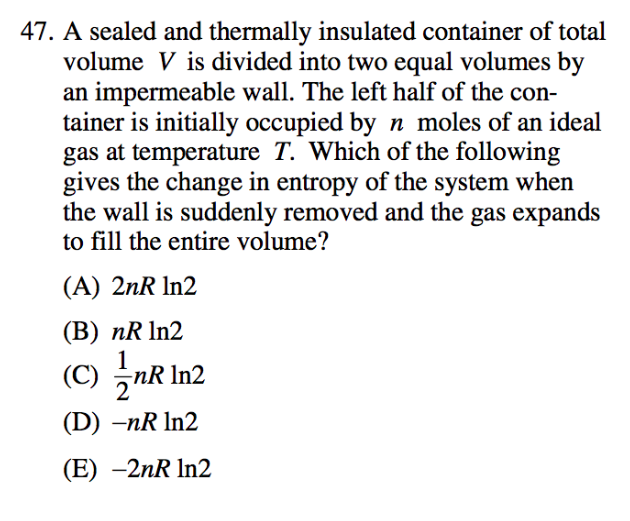 Since the process is irreversible, the total change in entropy (for the whole system) must be positive. This eliminates option (D) and (E) in the multiple choice question.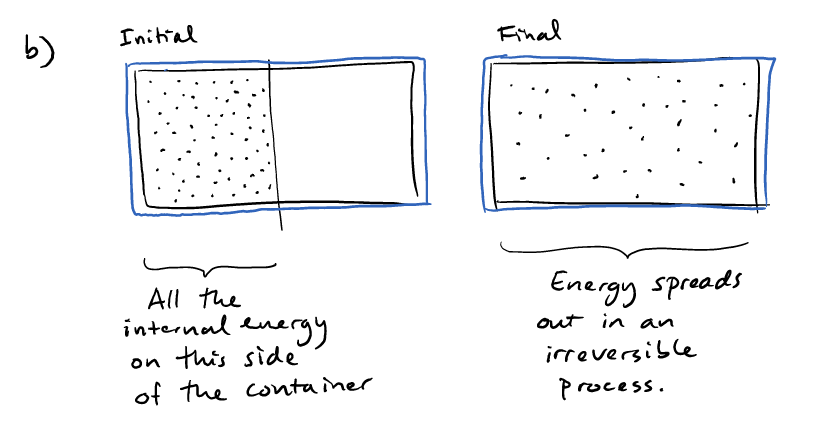
I cannot describe this process as a simple “flow of heat between objects”, so I cannot use the relationship \(\Delta S = Q/T\).
The volume doubles while \(N\) and \(U\) stay constant (there is no change in the internal energy of the gas). I'll put these quantitative statements into the expression for total entropy of a monatomic ideal gas. \begin{align} S_\text{initial} = k_\text{B} \ln\left(C V^N U^{3N/s}\right) \quad \quad \quad S_\text{final} = k_\text{B} \ln\left(C (2V)^N U^{3N/s}\right)\\ \frac{\Delta S}{k_\text{B}} = \ln C + N \ln (2V) + \frac{3N}{2} \ln U - \ln C - N \ln V - \frac{3 N}{2} \ln U \end{align} \begin{align} \Delta S &= k_\text{B} N \left(\ln(2V) - \ln V\right)\\ &= k_\text{B} N \ln 2 \end{align} This is option (B) in the GRE question.
- (T3M.7) The multiplicity of an ideal monatomic gas with \(N\) atoms, internal energy \(U\), and volume \(V\) turns out to be roughly
\begin{align}
\Omega (U, V, N) = CV^NU^{\left(\frac{3 N}{2}\right)}
\end{align}
where \(C\) is a constant that depends on \(N\) alone. Use this expression, together with the fundamental definition of temperature, and they fundamental definition of entropy, to find \(U\) as a function of \(N\) and \(T\) for an ideal gas.
- Heat Pump
S1 4741S
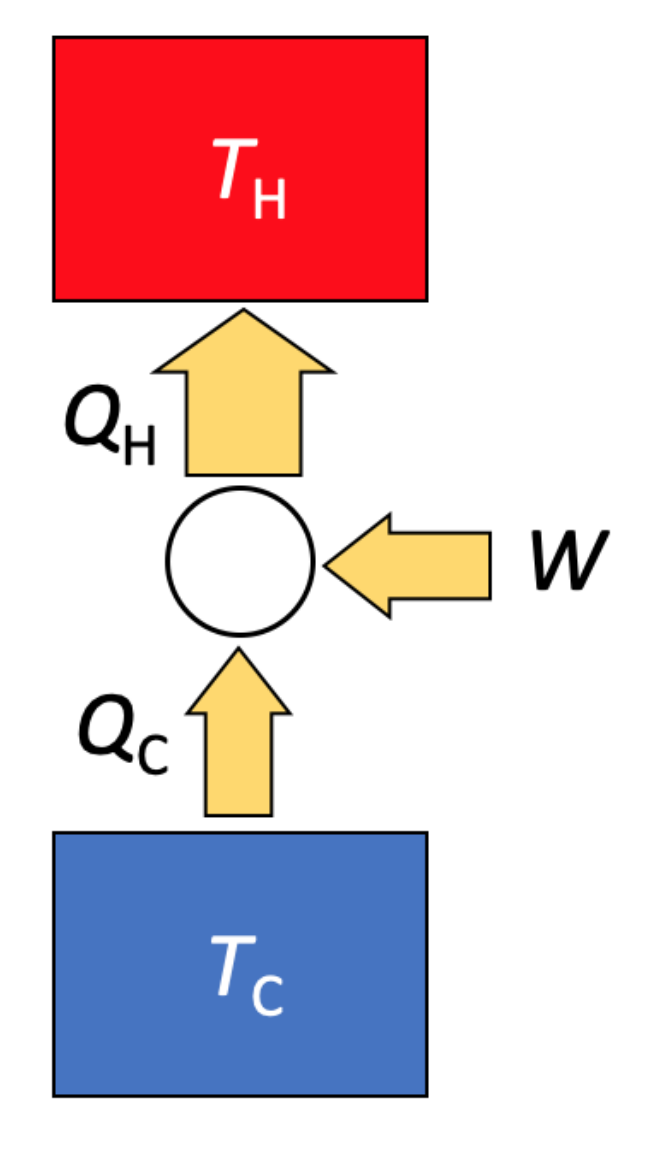
The diagram shows a machine (the white circle) that moves energy from a cold reservoir to a hot reservoir. We will consider whether a machine like this is useful for heating a family home in the winter when the temperature inside the family home is \(T_\text{H}\), and the temperature outside the house is \(T_\text{C}\). To quantify the performance of this machine, I'm interested in the ratio \(Q_\text{H}/W\), where \(Q_{\text{H}}\) is the heat energy entering the house, and \(W\) is the net energy input in the form of work. (\(W\) is the energy I need to buy from the electricity company to run an electric motor). Starting from the 1\(^{\text{st}}\) and 2\(^\text{nd}\) laws of thermodynamics, find the maximum possible value of \(Q_\text{H}/W\). This maximum value of \(Q_\text{H}/W\) will depend solely on the ratio of temperatures \(T_\text{H}\) and \(T_\text{C}\).
We are tring to maximize the heat flowing into the high temperature reservoir for a given amount of work input. By the first law of thermodynamics we know that
\[Q_{\text{C}}+W = Q_{\text{H}}\]
If I fix W, then increasing \(Q_{\text{C}}\) will increase \(Q_\text{H}\).
By the second law of thermodynamics we know \begin{align} -\frac{Q_{\text{C}}}{T_{\text{C}}} + \frac{Q_{\text{H}}}{T_{\text{H}}} \geq 0 \end{align}
If we use the beggest \(Q_{\text{C}}\) then \begin{align} \frac{Q_{\text{C}}}{T_{\text{C}}} = \frac{Q_{\text{H}}}{T_{\text{H}}}\\ \rightarrow \frac{Q_{\text{C}}}{Q_{\text{H}}} = \frac{T_{\text{C}}}{T_{\text{H}}} \end{align}
We can combine the two equations to get the efficiency: \begin{align*} \epsilon = \frac{Q_\text{H}}{W} &= \frac{Q_\text{H}}{Q_\text{H}-Q_\text{C}}\\[6pt] \frac{1}{\epsilon} &= \frac{Q_\text{H}-Q_\text{C}}{Q_\text{H}} \\[6pt] &= 1- \frac{Q_\text{C}}{Q_\text{H}} \\[6pt] &= 1- \frac{T_\text{C}}{T_\text{H}} \\[6pt] &= \frac{T_{\text{H}}-T_{\text{C}}}{T_\text{H}} \\[6pt] \epsilon &= \frac{T_\text{H}}{T_{\text{H}}-T_{\text{C}}} \end{align*}
To understand this answer, I can consider a few special cases. If \(T_\text{H} = T_{\text{C}}\), then no work is needed. If \(T_{\text{C}}\rightarrow 0\), then \(Q_\text{H} = W\). All the heat must come from work.
I'm also noticing that the difference in temperature between the reservoirs is going to be smaller than the temperature of the hot reservoirs, so I'm expecting efficiencies that are bigger than 1.
Sensemaking: Choose realistic values of \(T_\text{H}\) and \(T_\text{C}\) to describe a family home on a snowy day. Based on your temperature estimates, what is the maximum possible value of \(Q_\text{H}/W\)?
For a snowy day, let \(T_{\text{C}} = 270\) K and \(T_\text{H} = 290\) K.
Substituting that into my equation, I get \(Q_\text{H}/W = 290/20 \approx 15\).
That sounds great! How well do real heat pumps perform? See wikipedia: “Heat Pump”, subsection “performance considerations.” It says that \(Q_\text{H}/W \approx 3.2-4.5\) for a unit you can install at your house.
- Thermal energy in the earth's atmosphere
S1 4741S
Thermal energy is stored in all materials on Earth, including the air, water and rocks. The air is composed mostly of diatomic molecules such as N\(_2\) and O\(_2\).
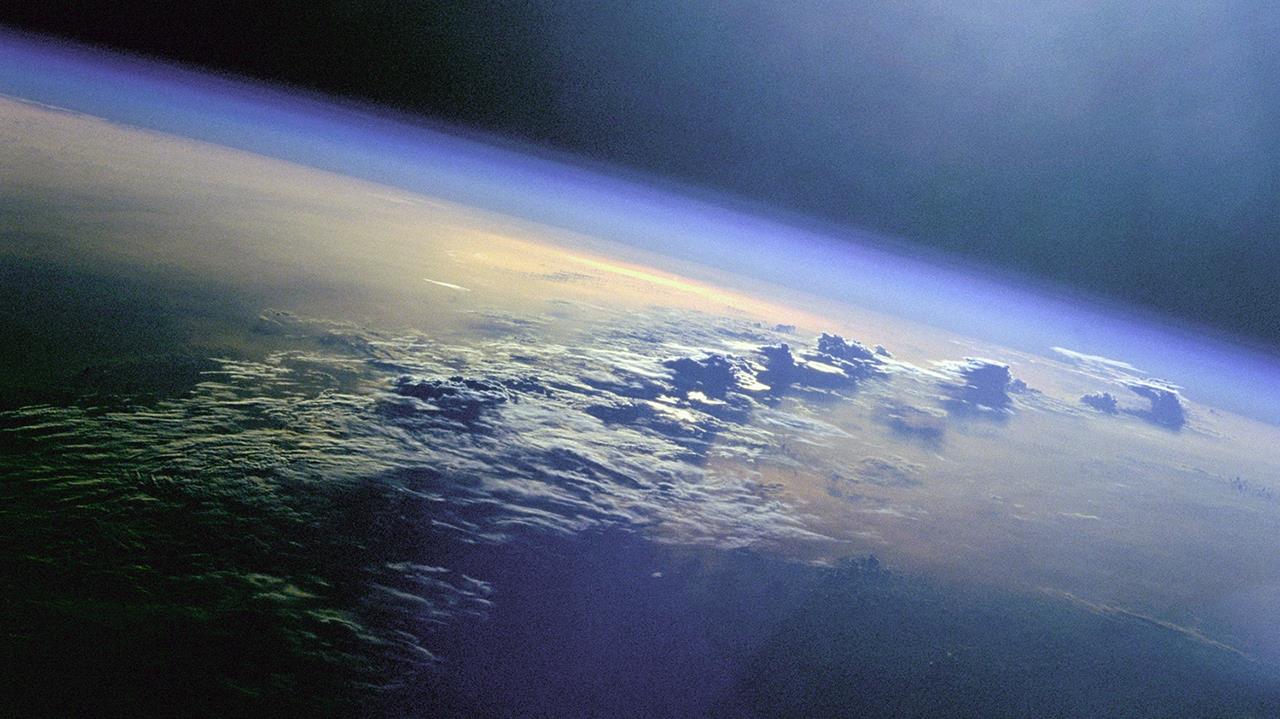
Use Google to look up the mass of the earth's atmosphere. Now, exercise some skepticism and make sure that Goggle's answer is consistent with other facts about the earth: Air pressure at sea level is about 100 kPa and the radius of the earth is about 6400 km. The air pressure at sea level (force per unit area) is caused by the downward force of gravity acting on the atmosphere directly above a unit area. The thickness of the atmosphere is much much less than the radius of the earth. Give your argument supporting or refuting the internet's value for the mass of the earth's atmosphere.
Google says the mass of the Earth's atmosphere is \(5\times10^{18}\) kg. I want to check this. First, consider a column of air.
Every square meter of earth's surface has 10,000 kg of air directly above it. Radius of the Earth is \(\approx\) 6400 km. \begin{align} m_\text{atm} &= \left(4 \pi r_\text{earth}^2\right)(m_\text{sqr})\\ &= 4 \pi (6.4\times10^6 \text{ m})^2 (10^4 \text{ kg/m}^2) \\ &= 5\times 10^{18} \text{ kg} \end{align}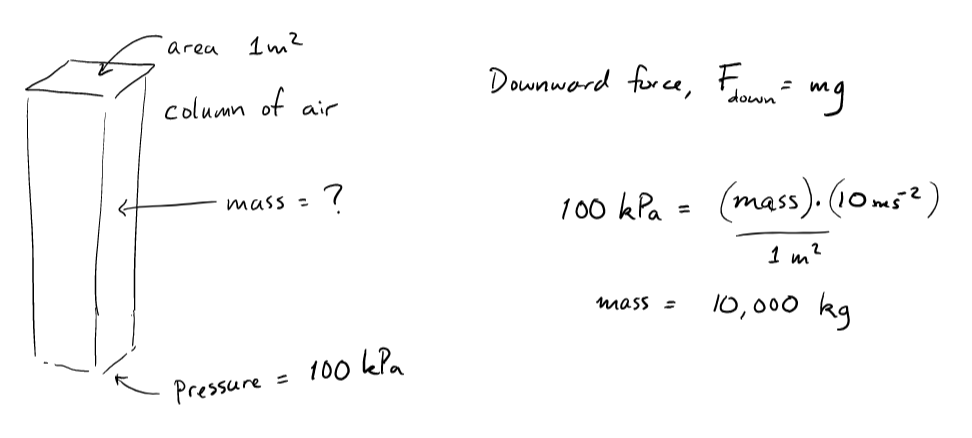
We know that between 1955 and 2010, the temperature of the top 2000 meters of the ocean rose by about 0.05 C. Given this fact, assess the validity of the following statement:
“If the same amount of heat that has gone into the top 2000 meters of the ocean between 1955-2010 had gone into the lower 10 km of the atmosphere, then the atmosphere would have warmed by about 20\(^\circ\)C (36\(^\circ\)F).”
Is this statement reasonable, or ridiculous? Show your calculations that support your conclusion. Your starting assumptions will include the specific heat capacity of air and water at constant pressure, and a reasonable guess regarding the fraction of the earth's surface that is covered with ocean.
I need to calculate the mass of water in top 2000 m of ocean. \begin{align} \text{Surface area of earth} &= 4 \pi R_\text{earth}^2\\ &=4 \pi (6.4\times10^{6})^2\\ &= 5.14\times10^{14} \text{ m}^2\\ \\ \text{Volume of water} &= \left(\frac{2}{3}\right)(5\times10^{14})(2\times10^3) \text{ m}^3\\ &\text{The 2/3 is because 2/3 of the planet is ocean}\\ &= 7\times10^{17}\text{ m}^3\\ \\ \text{Mass of water} &= (10^3 \text{ kg/m}^3)(7\times10^{17} \text{ m}^3) = 7\times10^{20} \text{ kg} \end{align} Now we can find the heat required to raise the ocean temperature by 0.05\(^\circ\) C. \begin{align} Q &= m c_\text{p,water} \Delta T \\ &= [7\times10^{20} \text{ kg}][4.2 \text{ kJ}\cdot\text{kg}^{-1}\cdot\text{K}^{-1}][5\times10^{-2} \text{ K}]\\ &= 10^{20}\text{ kJ} \end{align} Heat required to raise air temperature by 20\(^\circ\)C. \begin{align} Q &= m c_\text{p,air} \Delta T \\ &= (5\times10^{18} \text{ kg})(1 \text{ kJ}\cdot\text{kg}^{-1}\cdot\text{K}^{-1})(20 \text{ K})\\ &= 10^{20}\text{ kJ} \end{align}
Note that I've used the heat capacity of air at constant pressure (\(c_\text{p,air} \approx 1 \text{ kJ}\cdot\text{kg}^{-1}\cdot\text{K}^{-1}\)), which is greater than the heat capacity of air at constant volume (\(c_\text{v,air} \approx 0.7 \text{ kJ}\cdot\text{kg}^{-1}\cdot\text{K}^{-1}\)). The reason for this difference is the following. If we heat a gas while keeping the pressure of the gas constant, then some heat energy must be turned into work - expanding the volume of the gas. Thus, less heat energy goes into raising the internal energy of the gas.
When answering this question, \(c_\text{p,air}\) is the correct choice. I won't dock points if you used \(c_\text{v,air}\). For example, if you estimated the heat capacity of air using the equipartition theorem, you should have found a reasonable value for \(c_\text{v,air}\).
The statement appears to be true, the same amount of heat is required to either raise the ocean temp by 0.05\(^\circ\)C or to raise the air temp by 20\(^\circ\)C.