Periodic Systems: Spring-2026
HW 9 (SOLUTION): Due Day 23
- 4 Coupled Masses
S1 5500S
Consider a system of four masses coupled by springs of spring constant \(k\) to form a ring. You should consider this as a 1D system with periodic boundary condition. Initially we hold three of the masses at equilibrium location, and displace the other one by \(\delta x\). At time zero, we release the displaced mass at zero velocity.
- If all masses are equal to \(m\), the normal modes can be solved by the following matrix equation: \(K\mathbf{x} = -\omega^2 m\mathbf{x}\). Find \(K\), you should try to identify the pattern so that in the future you can write down the matrix \(K\) directly.
\begin{eqnarray*} \left\{\begin{array}{cccc}-2k&k&0&k\\k&-2k&k&0\\0&k&-2k&k\\k&0&k&-2k\end{array} \right\}\mathbf{x} =K\mathbf{x}= -m\omega^2\mathbf{x} \end{eqnarray*}
- What are the eigenfrequencies and normal modes of the system?
We apply the eigenvalue equation, which in this context is: \[det|Kx-m\omega^2 x|=0\] Which let's us solve for our \(\omega\)'s, then for each \(\omega\), we solve for a vector that makes this true: \begin{align} K\mathbf{x}_n =-\omega^2_n\mathbf{x}_n \end{align} Or we solve generally for \(\mathbf{x}_n=\left\{\begin{array}{c}a_n\\b_n\\c_n\\d_n\end{array}\right\}\): \begin{align} \left\{\begin{array}{cccc}-2k+\omega^2_n&k&0&k\\k&-2k+\omega^2_n&k&0\\0&k&-2k+\omega^2_n&k\\k&0&k&-2k-\omega^2_n\end{array} \right\}\left\{\begin{array}{c}a_n\\b_n\\c_n\\d_n\end{array}\right\} =0 \end{align} If we do so, we get: \begin{eqnarray} \mathbf{x}_1 &=&\left\{\begin{array}{c}1\\1\\1\\1\end{array}\right\},\,\omega_1 =0\\ \mathbf{x}_2 &=&\left\{\begin{array}{c}1\\-1\\1\\-1\end{array}\right\},\,\omega_2 =\sqrt{4k/m}\\ \mathbf{x}_3 &=&\left\{\begin{array}{c}1\\0\\-1\\0\end{array}\right\},\,\omega_3 =\sqrt{2k/m}\\ \mathbf{x}_4 &=&\left\{\begin{array}{c}0\\1\\0\\-1\end{array}\right\},\,\omega_4 =\sqrt{2k/m} \end{eqnarray}
- What are the equations of motion for the system?
When we're solving this 2nd order differential equation, we expect oscillatory solutions. This works for all but \(\omega_1=0\) which we have to remember it still needs two inital conditions (position and velocity) and so we add a constant plus another coefficent times t (this 2nd coefficent is the initial velocity). We could do this with any oscillatory solution used in PH424, but we will use the sine and cosine version of oscillatory solution since all the coefficents next to cosine are inital positions and all coefficents next to sine are initial velocities, and this is physically more intuitive for us to solve. Thus, the time evolution should be expressed as
\begin{eqnarray} \mathbf{x}(t) &=& (\alpha_1+\beta_1t)\mathbf{x}_1\nonumber\\ &+&(\alpha_2\cos\omega_2t+\beta_2\sin\omega_2t)\mathbf{x}_2\nonumber\\ &+&(\alpha_3\cos\omega_3t+\beta_3\sin\omega_3t)\mathbf{x}_3\nonumber\\ &+&(\alpha_4\cos\omega_4t+\beta_4\sin\omega_4t)\mathbf{x}_4 \end{eqnarray}
We are supposed to find all the parameters using the initial condition. DO NOT make it a problem of solving 8 unknowns from 8 equations. Instead, do some guessing.
First of all \(\alpha_1\) and \(\beta_1\) corresponding to the center of mass position and velocity at \(t=0\). Therefore \(\alpha_1=\frac{\delta x}{4}\), \(\beta_1=0\).
Second, since at zero time mass 2 and mass 4 are not disturbed, we do not expect to excite the mode \(\mathbf{x}_4\). So \(\alpha_4=\beta_4=0\). It is then easy to verify that the initial position can be expressed as
\begin{eqnarray} \mathbf{x}(0) = \frac{\delta x}{4}(\mathbf{x}_1 +\mathbf{x}_2+2\mathbf{x}_3) \end{eqnarray}
There is no motion at \(t=0\), so we can easily set all \(\beta\)'s equal to zero. Or if you want to make it more mathy:
\begin{eqnarray} 0=\partial_t\mathbf{x}(0) = \beta_1\mathbf{x}_1+\sum_{i=2}^4\omega_i\beta_i\mathbf{x}_i \end{eqnarray}
The only way of making a zero from orthogonal vectors is making all their coefficients to be zero. So again all \(\beta\)'s equal to zero.
In summary, we have
\begin{eqnarray} \mathbf{x}(t) = \frac{\delta x}{4}(\mathbf{x}_1 +\cos\omega_2t\mathbf{x}_2+2\cos\omega_3t\mathbf{x}_3) \end{eqnarray}
- If all masses are equal to \(m\), the normal modes can be solved by the following matrix equation: \(K\mathbf{x} = -\omega^2 m\mathbf{x}\). Find \(K\), you should try to identify the pattern so that in the future you can write down the matrix \(K\) directly.
- Chain of Coupled Pendulums
S1 5500S
Consider an infinite periodic system of coupled pendulums. The length of each pendulum is \(L\). The moving masses have mass \(m\). A portion of the system is shown below. The springs between the masses are identical and have spring constant \(\kappa\). At equilibrium the masses lie on the \(x\)-axis with a spacing \(a\). Assume that motion is restricted to the plane, and that the amplitude of motion is small.
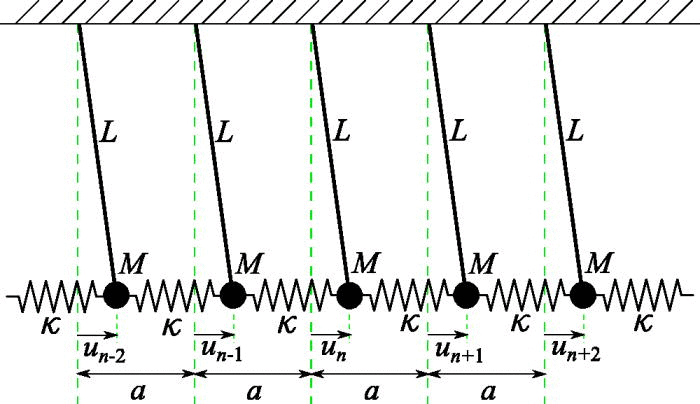
- Find the dispersion relation for small oscillations of this system.
I begin by working out the force equation on a single ball. I could use either angular coordinates or Cartesian coordinates.
\begin{align*} x_i &= L\sin\phi_i \\ &\approx L\phi_i \\ y_i &= L(1-\cos\phi_i) \\ &\approx \frac12L\phi_i^2 \\ &= \frac12 \frac{x_i^2}{L} \end{align*}
I will just use \(x_i\) as my coordinates for simplicity. Angular coordinates would work equally well. Now, let's look at the gravitational potential energy to figure out the pendulum force on the ball:
\begin{align*} V_g &= mg\frac12 \frac{x_i^2}{L} \\ F_g &= -\frac{dV_g}{dx} \\ &= -\frac{mg}{L}x_i \end{align*}
Now we can put this together into Newton's Second Law \(\left(\sum F = m \ddot{x}\right)\), using Hooke's Law \(\left(F=-k\Delta x\right)\) for the ordinary springs to find the force on ball \(i\).
\begin{align*} m\ddot x_i &= -\frac{mg}{L}x_i - \kappa(x_i-x_{i-1}) - \kappa(x_i-x_{i+1}) \\ &= -\left(\frac{mg}{L}+2\kappa\right)x_i + \kappa x_{i-1} + \kappa x_{i+1} \end{align*}
We can interpret \(x_{i \pm 1}\) as a up/down symmetry matrix acting on the state \(x_i\) like so: \begin{align} x_{i+1}=S^\uparrow x_i\\ x_{i-1}=S^\downarrow x_i \end{align} We can pull \(x_i\) out of each term now: \begin{align*} m\ddot x_i &= -\left(\frac{mg}{L}+2\kappa\right)x_i + \kappa x_{i-1} + \kappa x_{i+1}\\ &= \left[-\left(\frac{mg}{L}+2\kappa\right)I + \kappa S^\downarrow + \kappa S^\uparrow\right]x_i \end{align*} Where we inserted an \(I\), the identity matrix, to keep the integrity of the matrix equation after we pulled \(x_i\) out. Now if we want to interpret our force as being spring-like, we see that the spring coefficent would be the terms inside the bracket. Therefore we can write down the \(K\) matrix for the system:
\begin{eqnarray*} K= -(mg/L+2\kappa)I + \kappa (S^\uparrow + S^\downarrow) \end{eqnarray*}
We know our solutions will be be a simple harmonic oscillator, so we know our position will have time dependence of \(e^{i\omega t}\), which means our accerlation will take on the form \(\ddot{x}_i=-\omega^2x\) and we know from class that our eigenvalue equations for our symmetry operators are of the form: \begin{align} S^\uparrow x_i=\lambda_\alpha x_i=e^{ika}x_i\\ S^\downarrow x_i = \frac{1}{\lambda_\alpha}x_i=e^{-ika}x_i \end{align}
Where we can plug these in see: \begin{align*} m\ddot x_i &= \left[-\left(\frac{mg}{L}+2\kappa\right)I + \kappa S^\downarrow + \kappa S^\uparrow\right]x_i\\ -m\omega^2x_i &= \left[-\left(\frac{mg}{L}+2\kappa\right)I + e^{-ika} + \kappa e^{ika}\right]x_i \end{align*} Now we can cancel \(x_i\) on both sides (transforming this into a regular equation instead of a matrix one!) and recognize our Euler's formula for cosine: \(2\cos(ka)=e^{ika}+e^{-ika}\). From this, we have the dispersion relation, \begin{align*} -m\omega^2 &= -\frac{mg}{L}-2\kappa + 2\kappa\cos(ka) \\ \omega &= \sqrt{\frac{g}{L}+\frac{2\kappa}{m}(1 - \cos(ka))} \\ \omega &= \sqrt{\frac{g}{L}+\frac{2\kappa}{m}\sin^2\left(\frac{ka}{2}\right)} \end{align*}
Explore the dispersion relation. This part is deliberately open ended to encourage you to ask questions yourself. Such questions could include: what are the interesting features (max freq, min freq, periodicity in the dispersion relation)? What is different about this system compared to others you have studied? Are there limiting cases as you change \(\kappa\)? How quantitative can you be?
As the explanation says, there are lots of things you can do here. To my mind the most interesting feature in contrast to the simple chain of coupled oscillators is that at \(\omega(k=0) = \sqrt{g/L}\), rather than zero. This reflects the fact that the pendulums pull everything back to its equilibrium position.
If we consider the group velocity, we see that rather than having a constant group velocity for small \(k\), our group velocity is proportional to \(k\) (since \(\omega \propto \text{constant} + k^2\) for small \(k\)), which makes this system behave more like a massive particle than a massless particle. In fact, we could work out an effective mass, which would be the mass of a quantum particle with the same dispersion relation.
To be quantitative, at small \(k\) \begin{align*} \omega &= \sqrt{\frac{g}{L}+\frac{2\kappa}{m}\sin^2\left(\frac{ka}{2}\right)} \\ &\approx \sqrt{\frac{g}{L}+\frac{\kappa a^2}{2m}k^2} \\ &= \sqrt{\frac{g}{L}}\sqrt{1+\frac{\kappa a^2 L}{2m g}k^2} \\ &\approx \sqrt{\frac{g}{L}}\left(1+\frac{\kappa a^2 L}{4m g}k^2\right) \end{align*}
The dispersion relation, as other examples we did in class is periodic. The smallest period is called Brillouin zone, which is from \(-\pi/a\) to \(\pi/a\) just as \(N\) masses on a ring.
At zone edge, the frequency has its maximum value of \(\omega = \sqrt{\frac{g}{L}+\frac{2\kappa}{m}}\), while the minimum frequency is at \(k=0\), and is \(\omega = \sqrt{g/L}\), which is just the frequency of our pendulums if nothing were connected.
At zone center (the minimum frequency) all the masses are swinging together, so none of the springs are stretched. At zone edge (max freq), alternating masses are going in alternating directions, so you maximize the spring action.
- Find the dispersion relation for small oscillations of this system.